I have been trying to establish an outdoor mushroom culture directly in the ground, but not very successful so instead I started indoor culture and naturalize the outdoor patch from that.
Here is some jar culture of Pleurotus ostreatus. This is an easy mushroom to grow. In fact, this batch got contaminated with green mold, but miraculously recovered and mycelium completely dominated the substrate afterword.
This gives me a clue about contamination and succession of mushroom mycelium. Natural environment is more complex array of microorganisms and potentially contaminating ones, but as long as the growing condition shifts to what's more desired by mushrooms, then the previous contaminant organisms just give their place to succeeding mushroom.
In this case, easy sugar and starch got consumed by green mold and some bacteria, but once they are consumed, it no longer needed to be there and mushroom that can decompose more complex fiber and lignin was called for.
This condition also applies to gardens and farm fields. If we can keep the field clean or get the field cleaned by some organisms, then beneficial fungi can start growing, which in turn create nutrient cycle without fertilizers and potentially harmful side effect like pest and disease problems.
Often times, where I find mushrooms growing in tea fields and vegetable fields is barely disturbed by pests and diseases. The soil drainage is so good that right after heavy rain, it already feels dry to touch. Also, it keeps the soil dry in moist environment and keeps certain pest problems like mildew and fungal infection minimal. Though I haven't grown any tomatoes or cucumbers in recent years, I can't tell if this works as good as it should, since I don't mind not having tomatoes and cucumbers in my diet much, but we got some seedlings of cucumbers this year so we'll see how it goes.
This is natural farming blog. We talk about green tea, natural farming and lifestyle on the big island of Hawaii.
Sunday, April 25, 2010
Sunday, April 4, 2010
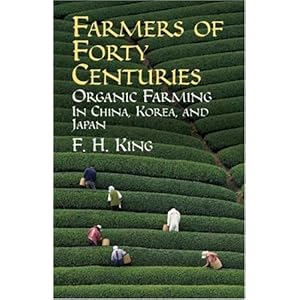
Book: "Farmers of Forty Centuries, Organic Farming in China, Korea, and Japan" by F. H. King
I have been reading this book on online book sites below, but got tired of staring at computer monitor, so I finally bought the book.
Another title: "Farmers of Forty Centuries: Or: Permanent Agriculture in China; Korea; and Japan"
Read online? go to the end of this page.
Book Description:
F. H. King lived before petroleum era of chemical fertilizers and pesticides and visited China, Korea and Japan and put his observation of their permaculture system and organic farming practices into this great book. Lots of in-depth look on many different aspects of local lifestyle. Many photos and illustrations accompany the text to make it easily digestible.
There are many examples of low tech tools and techniques that they use in Japan, China and Korea although it might be too costly for us now, I am sure that we can get good insight.
The book also discusses not only how they had sustained cultivation and farm-community designs for over thousands of years, but also means of distribution, trade and international trade in pre-petroleum sort of manner.
He also talks about specific industries like rice, silk and tea.
Online text
Google book:
http://books.google.com/books?id=NOpEn8H1wmsC&printsec=frontcover&dq=Farmers+of+Forty+Centuries&source=gbs_similarbooks_s&cad=1#v=onepage&q=&f=false
http://www.journeytoforever.org/farm_library.html#king
Buy online at Amazon.com
http://www.amazon.com/Farmers-Forty-Centuries-Organic-Farming/dp/0486436098/ref=pd_cp_b_1
Another title: "Farmers of Forty Centuries: Or: Permanent Agriculture in China; Korea; and Japan"
Read online? go to the end of this page.
F. H. King lived before petroleum era of chemical fertilizers and pesticides and visited China, Korea and Japan and put his observation of their permaculture system and organic farming practices into this great book. Lots of in-depth look on many different aspects of local lifestyle. Many photos and illustrations accompany the text to make it easily digestible.
There are many examples of low tech tools and techniques that they use in Japan, China and Korea although it might be too costly for us now, I am sure that we can get good insight.
The book also discusses not only how they had sustained cultivation and farm-community designs for over thousands of years, but also means of distribution, trade and international trade in pre-petroleum sort of manner.
He also talks about specific industries like rice, silk and tea.
Online text
Google book:
http://books.google.com/books?id=NOpEn8H1wmsC&printsec=frontcover&dq=Farmers+of+Forty+Centuries&source=gbs_similarbooks_s&cad=1#v=onepage&q=&f=false
http://www.journeytoforever.org/farm_library.html#king
Buy online at Amazon.com
http://www.amazon.com/Farmers-Forty-Centuries-Organic-Farming/dp/0486436098/ref=pd_cp_b_1
Subscribe to:
Comments (Atom)
Green Tea in Natural Farming
Natural farming is a philosophy and farming method suggested by Masanobu Fukuoka. It is a way of doing less and letting nature take care of...
-
OPEN FARM DAY was nice and sunny. It was nice to talk story and visitors got to see what we are up to. People kept asking us if they can com...
-
Natural farming is a philosophy and farming method suggested by Masanobu Fukuoka. It is a way of doing less and letting nature take care of...
-
Today was my Kona day so I checked out a new spot by honokohau harbor. I started out on harbor side, and slowly worked my way around to t...